Best Timber Choices for Outdoor Decking in the Australian Climate
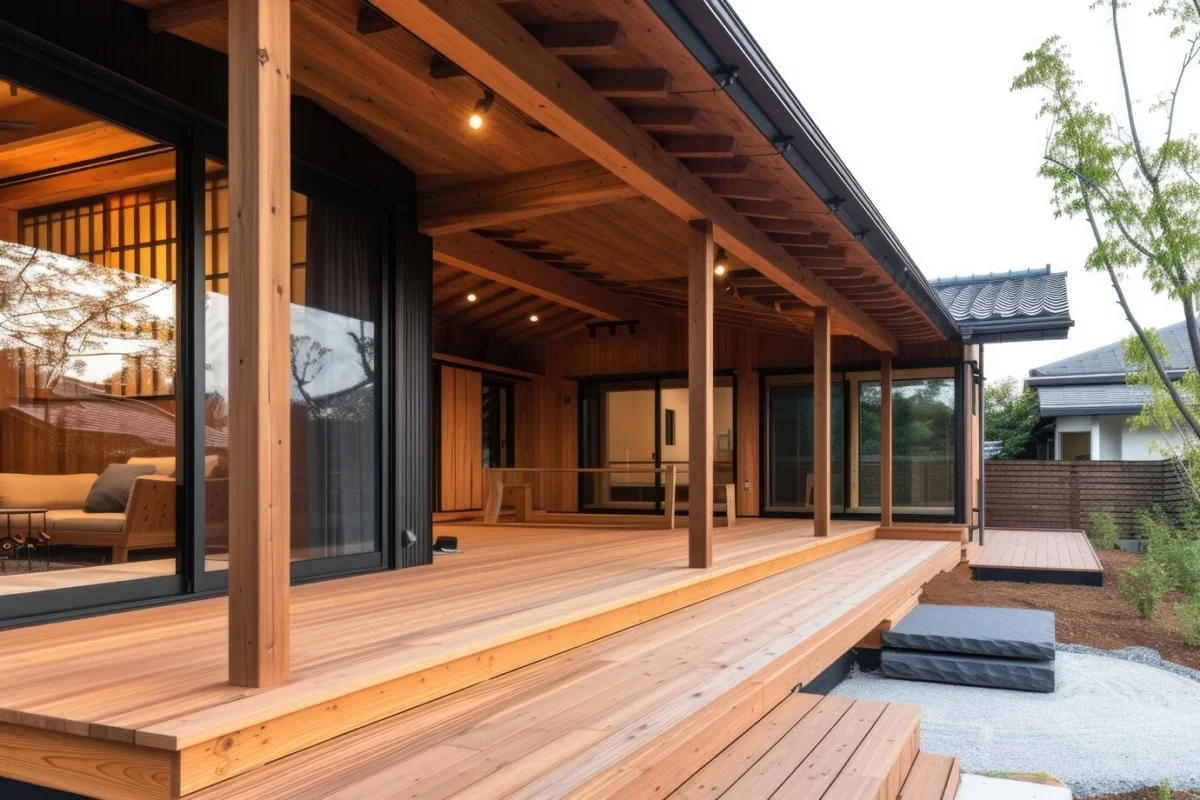
In the grand tradition of Australian homeownership, the backyard deck is more than just a platform for a barbecue; it is a sacred space. It is where Christmas lunch is served in 38°C heat, where the dog naps in the afternoon sun, and where we retreat to watch the sky turn pink with a glass of something cold.
But here’s the candid truth: Australia is a brutal environment for timber. We live on a continent that seems actively designed to destroy building materials. Between the blistering UV radiation of the Queensland sun, the bone-chilling frosts of the Tasmanian highlands, the salt mist of our 34,000 kilometres of coastline, and the ever-present threat of bushfires, your deck is in a constant state of war.
Choosing the right timber is not about picking a colour you like from a catalogue. It’s about selecting an ally that can withstand the gauntlet of the Australian climate for thirty years without surrendering to rot or warping.
We’re moving past the glossy brochures. We’re going to look at the physics, the biology, and the sheer grit of the best timber choices for your outdoor sanctuary, with a special focus on the undisputed heavyweight champion of the bush: Spotted Gum.
1. The Adversaries: What Your Deck is Up Against
Before we choose our champion, we have to understand the enemy. The Australian climate is a triple threat to timber.
The UV Laser Beam
The Australian sun is uniquely punishing. Due to our proximity to the Antarctic ozone hole and our clear skies, our UV levels are significantly higher than in Europe or North America. UV rays break down the lignin, the glue that holds wood fibres together, at a cellular level. Without a resilient timber, your deck will grey off, crack, and splinter within eighteen months.
The Moisture Rollercoaster
We are a land of droughts and flooding rains. Timber expands when it’s wet and shrinks when it’s dry. This constant cycling is what causes boards to cup or bow. In coastal areas, salt crystals can also become embedded in the wood fibres, drawing moisture deep into the grain and accelerating internal rot.
The Ember Attack
If you live near the bush, fire isn’t an abstract possibility; it’s a design requirement. The Bushfire Attack Level (BAL) rating of your property will dictate what you can and cannot build with. Choosing a naturally fire-resistant timber isn’t just a safety choice; it’s often a legal one.
2. The Heavyweight Champion: Spotted Gum
If there were a hall of fame for Australian timbers, Spotted Gum (Corymbiamaculata) would have its own wing. For anyone serious about a high-performance spotted gum deck, this is where the conversation begins and ends.
Why It Thrives?
Spotted Gum is a survivor. It grows primarily on the East Coast, from the hills of Queensland down to the Victorian border. Because it grows in such varied conditions, it has developed a cellular density that is almost unparalleled.
When you invest in spotted gum decking, you are investing in a Janka hardness of approximately $11.0 \text{kN}$. To put that in perspective, common Pine has a rating of about $3.3 \text{kN}$. This means a spotted gum deck is virtually immune to the high-impact “life” of a backyard it resists the scratching of dog claws, the dragging of heavy outdoor furniture, and the impact of the occasional dropped cast-iron pan.
The Visual Narrative
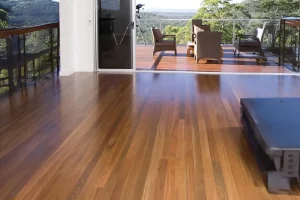
The reason homeowners fall in love with spotted gum decking boards is the aesthetic “chaos.” It doesn’t look like a uniform plastic floor. It ranges from pale lattes and greys to deep chocolate browns and olive tints. This natural variation is its greatest strength; it camouflages dust and minor scratches, making the deck look better as it ages.
Fire Resistance
Spotted Gum is one of the seven Australian hardwoods that are naturally fire-resistant. It is often approved for use in BAL-29 areas without any additional chemical treatment. If you are building in a leafy suburb, spotted gum timber decking provides a layer of structural security that most other materials simply can’t offer.
3. The Modernist: Blackbutt
If Spotted Gum is the rugged bushman, Blackbutt (Eucalyptus pilularis) is the coastal architect.
The Look
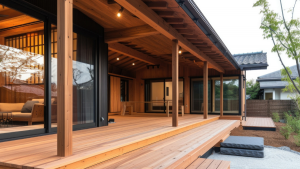
Blackbutt is famous for its Scandi aesthetic. It offers a much more consistent, pale straw to golden honey colour palette. It is the go-to choice for homeowners who want their deck to feel like an extension of their light-filled, modern interior.
Performance
While slightly softer than Spotted Gum (with a Janka rating of about $9.1 \text{kN}$), it is still a Class 1 durability timber. One of its standout features is its “dimensional stability.” It doesn’t move as much as other timbers in response to humidity, making it excellent for wider boards where cupping can be an issue. Like Spotted Gum, it is also highly fire-resistant (BAL-29).
4. The Global Hero: Merbau
You can’t talk about Australian decking without mentioning Merbau (Intsiabijuga). While it isn’t an Australian native (it’s primarily sourced from Southeast Asia), it has become a staple of our backyards.
The Good
Merbau is incredibly oily. These natural oils acts as a built-in preservative, making it exceptionally resistant to termites and rot. It has a beautiful, consistent reddish-brown hue that screams classic deck.
The Catch: The “Bleeding”
Merbau is famous for tannin bleed. If it gets wet before it’s sealed, it will leak a dark, tea-like liquid that can permanently stain concrete, pavers, and sandstone. If you choose Merbau, you must be prepared to leach the boards or seal them immediately to protect your other surfaces.
5. The Titan: Ironbark
Ironbark is the timber you choose when you want to build a deck that your grandchildren will still be walking on in fifty years.
Raw Power
Ironbark is so dense it often sinks in water. With a Janka rating that can exceed $14.0 \text{kN}$, it is a beast to work with-it will blunt saw blades and requires precise pre-drilling-but the result is a surface that is practically indestructible.
The Aesthetic
Ironbark comes in two main varieties: Red and Grey. Red Ironbark offers deep, moody burgundies, while Grey Ironbark provides a sophisticated, muted palette. It is the ultimate “prestige” timber for high-end builds.
6. The Anatomy of Selection: Durability Classes Explained
When you’re looking at spotted gum decking boards or any other timber, you’ll see a “Durability Class.” This isn’t just a marketing term; it’s a scientific measurement based on how the wood performs in the ground and above the ground.
- Class 1: Highly durable. Expected life of 40+ years above ground. (Spotted Gum, Ironbark, Merbau).
- Class 2: Durable. Expected life of 15–40 years above ground. (Blackbutt, Jarrah).
- Class 3/4: Not recommended for significant outdoor decking.
For the Australian climate, Class 1 is your gold standard. If you are building a deck that will be exposed to the rain and sun, do not settle for anything less than Class 2.
7. The Installation Creed: Why the Wood is Only Half the Battle
You could buy the most expensive spotted gum timber decking in the world, but if you install it poorly, it will fail. A deck is a system, not just a surface.
The Gap is Life
In Australia, timber will move. You must provide a gap (usually $4\text{ mm}$ to $5\text{ mm}$) between boards. This allows for airflow, which prevents rot on the underside of the boards, and gives the wood room to expand in the humid months.
Stainless Steel or Bust
Don’t use cheap screws. The salt in our air and the tannins in our hardwoods will eat through galvanised screws over time. Use 304 or 316-grade stainless steel screws. They are more expensive, but they won’t snap when the timber moves, and they won’t leave bleeding rust marks on your beautiful spotted gum deck.
Ventilation: The Silent Killer
Most decks rot from the bottom up. If your deck is low to the ground, you must ensure there is adequate cross-ventilation. Without airflow, moisture gets trapped under the deck, turning the space into a sauna that rots the joists and cups the boards.
8. The Ritual of Maintenance: To Grey or Not to Grey?
There are two schools of thought when it comes to maintaining hardwood.
The Naturalist (Silver-Grey)
Some homeowners love the weathered look. High-quality hardwoods like Spotted Gum will eventually turn a beautiful, silvery-grey if left un-oiled. While this looks great in coastal settings, it does mean the wood is more prone to surface checking. Even if you want the grey look, you should still apply a clear “penetrating sealer” to keep the moisture out.
The Traditionalist (Rich Tone)
If you want to keep that deep, vibrant look of your spotted gum decking, you have to oil it. In the Australian climate, this usually means an annual clean and oil ritual.
- Step 1: Clean with a deck wash (oxalic acid) to remove dirt and greyed fibres.
- Step 2: Apply a high-quality water-based or oil-based tint.
- Step 3: Enjoy the results for the next 12 months.
Investing in an Icon
Choosing the best timber for the Australian climate isn’t about finding the cheapest option; it’s about finding the most resilient one. Whether you opt for the architectural light of Blackbutt, the ironclad strength of Ironbark, or the versatile, fire-resistant beauty of spotted gum decking, you are making a statement about the value of your home.
A deck is an investment in your lifestyle. By choosing a high-density Australian hardwood and installing it with care, you are creating a space that will endure the sun, the rain, and the years, becoming the backdrop for decades of memories.
Frequently Asked Questions (FAQ)
1. Is Spotted Gum better than Merbau for coastal homes?
Yes, generally. While both are durable, spotted gum decking has less tannin bleed than Merbau, meaning it won’t stain your poolside pavers or concrete as easily. Additionally, Spotted Gum is slightly harder, making it better at resisting the abrasive effects of wind-blown sand.
2. Why are my spotted gum decking boards developing small cracks?
This is called checking. It’s a natural reaction to the timber drying out in the sun. It is usually aesthetic rather than structural. To minimize checking, ensure you oil your deck regularly, especially in the first twelve months after installation when the timber is seasoning.
3. Can I use treated pine for my deck frame and hardwood for the boards?
This is a very common practice in Australia. Treated Pine (H3 or H4) is excellent for the skeleton because it is cost-effective and treated against rot. Using a high-quality spotted gum timber decking for the surface gives you the beauty and durability where it counts.
4. How long should I wait before oiling my new spotted gum deck?
Many tradies suggest letting the timber breathe for 4–6 weeks to allow the tannins to leach out. However, modern high-quality oils can often be applied sooner if the wood is cleaned properly. Always follow the specific instructions on your oil tin, as the “weathering” period can vary by species.
5. Do I really need to pre-drill my hardwood decking boards?
Yes. Always. Australian hardwoods like Spotted Gum and Ironbark are so dense that if you try to drive a screw in without a pilot hole, you will either snap the screw or split the end of the board. It’s a tedious task, but it’s the difference between a professional finish and a DIY disaster.