The Architect’s Technical Masterclass: The Geometry of the Plank
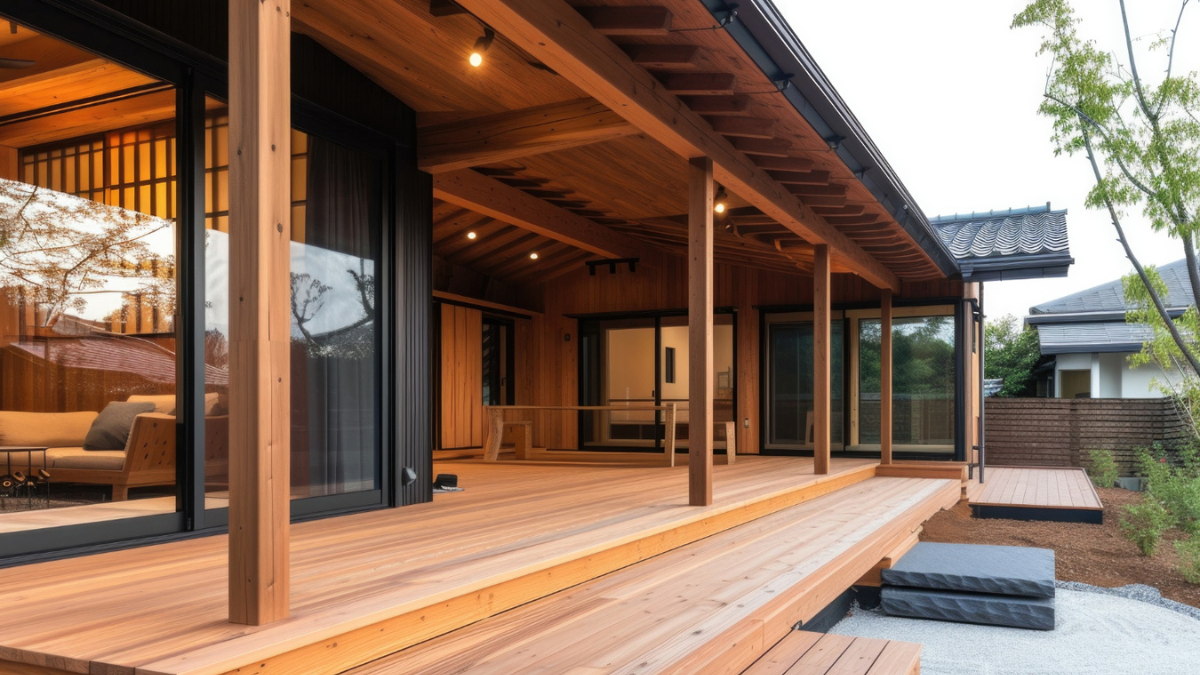
When we discuss the integrity of a deck, we often get distracted by the species of wood or the colour of the stain. But in the world of structural engineering, the most critical variable isn’t the name of the tree-it’s the dimensions of the board.
Thickness is the silent regulator of a deck’s lifespan. It dictates the bounce in your step, the maximum distance between your joists, and how many times you can refinish the surface before the structural integrity is compromised. In the Australian market, we often see a battle between the traditional 90mm merbau decking and the modern, expansive 140mm merbau decking.
This guide is a deep dive into the physics of thickness. We will move beyond what looks good and explore the mechanical properties that ensure your merbau deck doesn’t just survive the next five years, but thrives for the next thirty.
1. The Standard: Why 19mm is the Magic Number
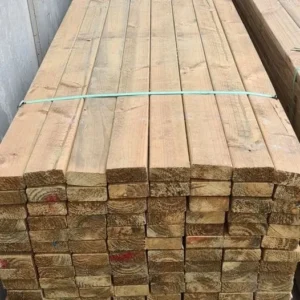
If you walk into any timber yard in Melbourne, Sydney, or Brisbane, you will find that the vast majority of merbau decking timber is milled to a thickness of $19\text{mm}$.
The Ratio of Stability
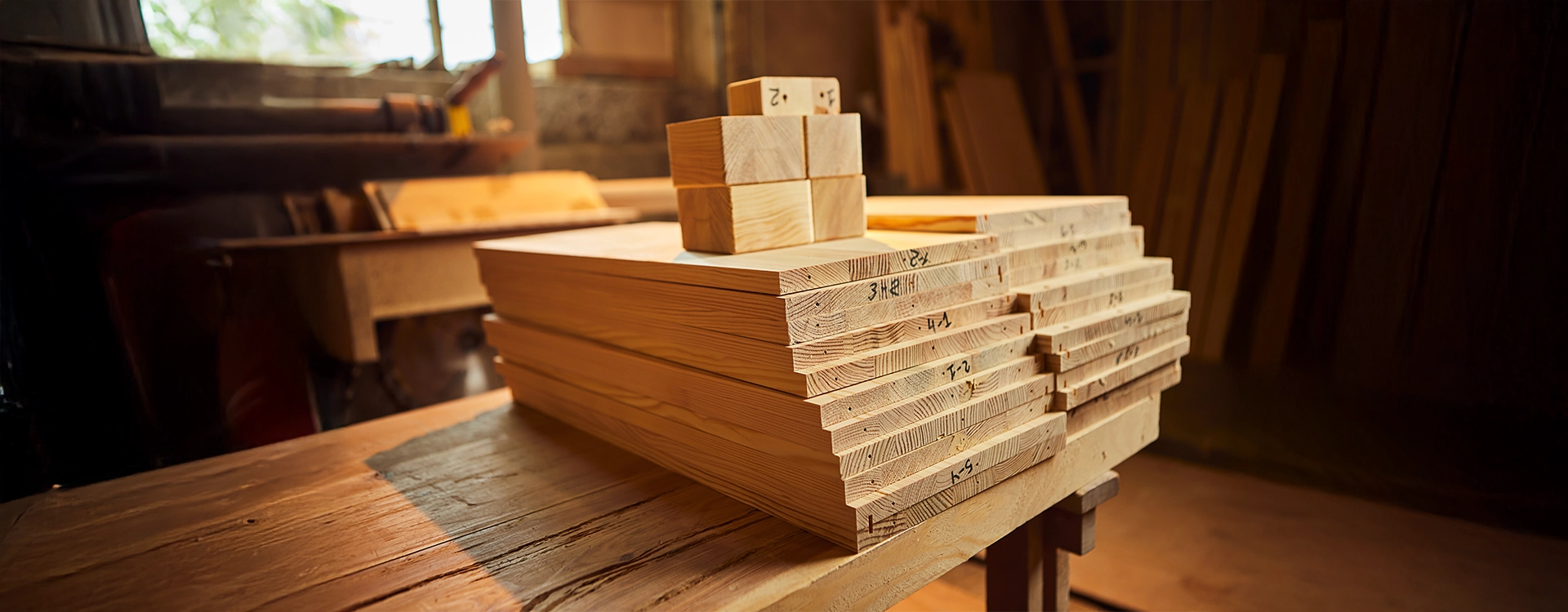
There is a reason why merbau decking 140 x 19 has become the industry benchmark. It represents the “Golden Ratio” of cost to performance. A $19\text{mm}$ board provides enough mass to resist warping while remaining light enough to be handled easily during installation.
From a physics perspective, the thickness $t$ of a board relates directly to its Moment of Inertia ($I$), which determines its resistance to bending. For a rectangular cross-section:
$$I = \frac{bh^3}{12}$$
Where $b$ is the width and $h$ is the thickness. Because thickness ($h$) is cubed, even a $2\text{mm}$ or $3\text{mm}$ increase in thickness provides a massive jump in the board’s stiffness and load-bearing capacity.
2. The Span Table: Thickness vs. Joist Spacing
The thickness of your merbau timber decking directly dictates how you build your skeleton (the sub-frame). If you choose a board that is too thin for your joist spacing, the deck will feel like a trampoline.
The Standard Rules of Thumb (Residential):
- 19mm Boards: Typically require a maximum joist span of 450mm.
- 22mm – 25mm Boards: Can often extend to a 600mm span.
- 32mm+ Boards: These are commercial grade and can span significantly further, though they are rarely used in residential backyards due to weight and cost.
If you are installing 140 merbau decking, you might be tempted to stretch your joists further apart to save on sub-frame costs. Don’t. While the board is wider, its $19\text{mm}$ thickness remains the limiting factor. Stretching a $19\text{mm}$ board across a $600\text{mm}$ span will lead to deflection, the visible dipping of the wood under foot traffic.
3. The Wide Board Paradox: Width vs. Thickness
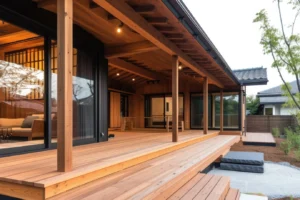
In 2026, the architectural trend has moved decisively toward the Wharf Style, using wide, chunky planks. This has led to the massive popularity of 140mm merbau decking. However, width introduces a new enemy: Cupping.
The Physics of Cupping
Wood expands and contracts as it absorbs moisture. Because the top of your merbau deck is exposed to the sun and the bottom is exposed to the damp earth, the moisture levels are never equal.
If a board is too wide relative to its thickness, the internal stresses will cause the edges of the board to curl upward.
- Safe Ratio: Generally, you want a width-to-thickness ratio of no more than 8:1.
- The Merbau Edge: Merbau decking 140 x 19 sits at a ratio of approximately 7.3:1. This is the upper limit of safety. If you were to go to a $150\text{mm}$ board at only $19\text{mm}$ thickness, the risk of cupping would increase by nearly $40\%$.
4. When to Go Thicker: The Cases for 22mm and 32mm
While $19\text{mm}$ is the standard for merbau decking timber, there are specific scenarios where you should upgrade your thickness.
Commercial and Public Spaces
If you are building a deck for a cafe, a public boardwalk, or a high-traffic office alfresco, $19\text{mm}$ is insufficient. Commercial codes usually mandate a minimum thickness of $22\text{mm}$ or $32\text{mm}$ to account for higher Point Loads.
Stairs and Cantilevers
If you are using merbau timber decking for stair treads, thickness is a safety requirement. A stair tread takes a concentrated impact every time someone steps on it. We often recommend using $32\text{mm}$ thick boards for stairs to ensure there is zero flex, which prevents the “creaking” common in older decks.
Heavy Furniture and Spas
Planning on a $2000\text{L}$ hot tub? The thickness of your boards matters less than the sub-frame, but the boards themselves need to resist the compression. A thicker board distributes the weight across the joists more effectively.
5. Material Comparison: Merbau vs. Others at 19mm
Not all $19\text{mm}$ boards are created equal. The density of the species changes how the thickness performs.
This is why merbau decking is the safe bet. It hits the sweet spot where $19\text{mm}$ provides enough strength without the extreme hardness that makes other timbers difficult to work with or prone to splitting at the ends.
6. The Refinishing Reservoir
One often overlooked benefit of thickness is the Refinishing Reservoir. Every time you sand back a deck to restore its color, you remove approximately $0.5\text{mm}$ to $1.0\text{mm}$ of the wood’s surface.
- A $19\text{mm}$merbau deck can realistically be sanded and refinished 3 to 4 times over its life.
- If you choose a thinner, cheaper $15\text{mm}$ or $16\text{mm}$ board (often found in low-grade imports), you may only get one sand out of it before the screws start to sit too shallow and the board loses its structural rating.
Investing in proper thickness is effectively buying insurance for the year 2040.
7. Installation Nuance: Screws and Pre-drilling
The thickness of your merbau decking timber dictates your hardware. For a standard $19\text{mm}$ board, you should be using 65mm stainless steel screws.
Why $65\text{mm}$?
- 19mm passes through the board.
- 6mm accounts for the gap/clearance.
- 40mm provides the “bite” into the joist.
If you upgrade to $32\text{mm}$ thickness, you must upgrade to $80\text{mm}$ or $100\text{mm}$ screws. Failing to match screw length to board thickness is the leading cause of popping boards in Australian decks.
Weighing Your Options
The decision between 90mm merbau decking and 140mm merbau decking is usually aesthetic, but the decision on thickness is purely functional. In the Australian climate, $19\text{mm}$ is the benchmark for a reason it balances the hydroscopic movement of the timber with the structural requirements of our building codes.
Before you buy, ask yourself:
- What is my joist spacing? (Stick to $450\text{mm}$ for $19\text{mm}$ boards).
- Am I in a high-traffic area? (Consider $22\text{mm}$ or $32\text{mm}$ for stairs).
- Am I choosing a wide board? (Ensure it’s at least $19\text{mm}$ to prevent cupping).
By understanding the physics of the plank, you ensure that your merbau deck is a solid, silent, and permanent addition to your home.
Frequently Asked Questions (FAQ)
1. Can I use 19mm Merbau for a commercial boardwalk?
Generally, no. Most commercial applications require a minimum of $22\text{mm}$ or $32\text{mm}$ to handle the increased load and to provide a longer wear-life. Always check your local council regulations or the Australian Standard AS 1684 for commercial specifications.
2. Why is my 140mm merbau decking cupping?
Cupping usually occurs if the boards are $19\text{mm}$ or thinner and there is poor ventilation underneath the deck. If moisture is trapped under the 140 merbau decking while the top is baked by the sun, the board will curve. Ensure you have at least $300\text{mm}$ of clearance under your deck for airflow.
3. Is 90mm merbau decking more stable than the 140mm version?
Yes. From a purely mechanical standpoint, the 90mm merbau decking has a lower width-to-thickness ratio, which makes it less susceptible to cupping and expansion issues. However, with proper installation and ventilation, the 140mm merbau decking is perfectly stable.
4. Should I buy thicker boards for a pool area?
It’s not strictly necessary, but pool areas are “high-moisture” zones. Choosing a thicker board can provide more resistance to the constant wetting and drying cycles. More importantly, ensure you use 316-grade stainless steel screws to prevent corrosion in the thicker timber.
5. Does the thickness of merbau timber decking affect the color?
No, the thickness is purely structural. However, thicker boards ($32\text{mm}$) often come from older, heartier parts of the tree, which can sometimes result in a slightly deeper, more consistent reddish-brown hue than younger, thinner sapwood boards.