When we talk about building for the long haul, we often get caught up in the glamour materials. We spend hours debating the perfect shade of spotted gum flooring or the tactile benefits of spotted gum timber flooring. But beneath the surface of every great project-whether it’s a luxury yacht, a coastal deck, or a high-traffic kitchen-lies the invisible architecture.
Plywood is a key component of engineered wood architecture. In Australia, where humidity and moisture are always trying to ruin things, choosing between Marine Plywood and Exterior Plywood can mean the difference between a structure that lasts and one that falls apart.
This isn’t just a matter of choosing a grade; it’s a matter of choosing an engineering philosophy. One is a soldier who fights on land and is built to withstand the occasional rain. The other is an elite maritime operative who can survive being fully submerged. Let’s tear apart the layers.
1. The Anatomy of the Bond: What Makes Plywood “Plywood”?
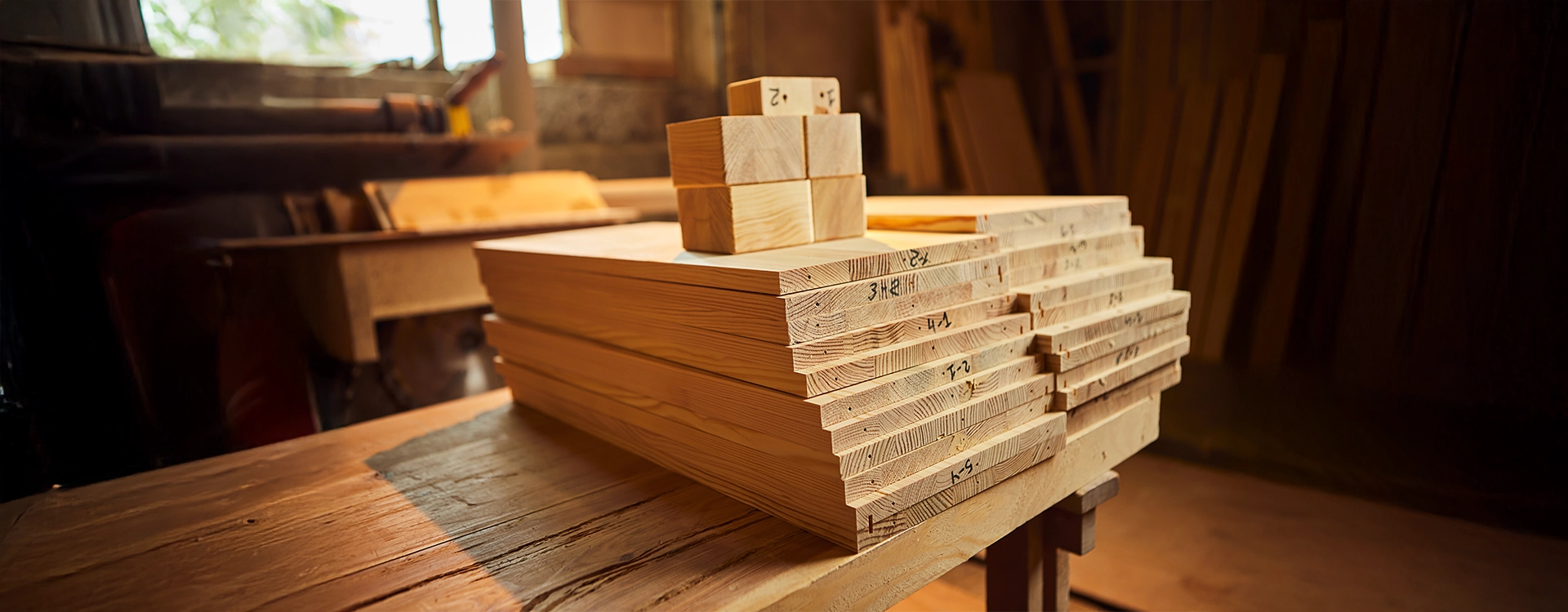
Before we look at the differences, we must understand the fundamental physics of the material. Plywood is a composite of thin wood veneers glued together. The genius of the design is in the grain orientation. Each layer is glued with its grain perpendicular to the one below it.
This cross-lamination solves the biggest problem with solid timber: anisotropy. While a solid piece of timber is strong along the grain but weak across it, plywood is equally strong in both directions. This stability is why it is the preferred subfloor for high-end spotted gum hybrid flooring, as it provides a rigid, flat base that prevents the “click-lock” systems of hybrid boards from snapping under pressure.
However, the strength of the board is entirely dependent on two factors:
- The Quality of the Glue.
- The Presence (or absence) of Voids.
2. Exterior Plywood: The Land-Based Guardian
Exterior plywood is the workhorse of the construction industry. It is designed for applications where the wood will be exposed to moisture and weather, but not permanent saturation. Think of it as your weather-resistant jacket; it’s great in a storm, but you wouldn’t want to swim across a lake in it.
The Adhesive: WBP Phenolic Resins
In 2026, the standard for Exterior Plywood is the use of WBP (Water Boil Proof) glue. These are typically phenolic resins. The “Boil Proof” test is literal: a sample of the wood is boiled in water for several hours to see if the layers delaminate.
If the glue holds, the board is rated for exterior use. This makes it an excellent choice for sheltered outdoor areas or as a moisture-resistant subfloor for laminate spotted gum flooring in laundry-adjacent hallways.
The Void Reality
The biggest difference you’ll find in Exterior Ply is the internal structure. Because it isn’t intended for maritime use, the manufacturing standards allow for small core gaps or voids.These are tiny air pockets where the internal veneers don’t perfectly meet.
In a land-based setting, these gaps are irrelevant. But in high-stress environments, these voids can trap moisture, leading to localized rot that you can’t see until the board structurally fails.
3. Marine Plywood: The Special Forces of Timber
Marine Plywood is often misunderstood as waterproof wood. Let’s be clear: There is no such thing as waterproof wood. Wood is biological; if it stays wet long enough, it will rot.
Marine Plywood is instead moisture-engineered. It is manufactured to a standard that is far more rigorous than its exterior cousin.
The Zero-Void Mandate
This is the Secret Sauce of Marine Ply. In a Marine-grade board, there are zero core gaps. Every layer of veneer is selected for its perfection. If you were to cut a Marine Ply board into a thousand tiny pieces, you would not find a single air pocket.
Why does this matter?
- Water Travel: In Exterior ply, water can wick through the core gaps, traveling deep into the board like a highway. In Marine ply, there are no highways.
- Structural Integrity: Without voids, the board has uniform density. This is why it is used for boat hulls and high-stress structural components. It provides a level of rigidity that even the most expensive spotted gum timber flooring relies on for a squeak-free life.
The Timber Species
While Exterior ply can be made from a variety of softwoods or hardwoods, true Marine Plywood is typically made from durable species like Hoop Pine or Gaboon/Okoumé. These species are selected for their density and their natural resistance to fungal decay.
4. The Flooring Connection: Subfloors and Stability
You might wonder why a blog about plywood is mentioning spotted gum hybrid flooring. The answer lies in the “Foundation Principle.”
Your finish floor the beautiful, honey-and-chocolate-toned spotted gum timber flooring is only as good as what it sits on.
Case Study: The Coastal Kitchen
Imagine you are installing spotted gum hybrid flooring in a coastal home with high humidity.
- Scenario A (Exterior Ply Subfloor): The humidity rises, moisture finds a small void in the Exterior ply subfloor, and over five years, a slight soft spot develops. Your hybrid flooring begins to dip slightly when you walk on it.
- Scenario B (Marine Ply Subfloor): The Marine ply remains dimensionally stable regardless of the coastal mist. Your floor stays perfectly flat for thirty years.
While Marine Ply is more expensive, for high-moisture zones, it is the “insurance policy” for your spotted gum timber flooring.
5. Key Differences: A Comparative Audit
Let’s break the comparison down into the metrics that matter for your project:
| Feature | Exterior Plywood | Marine Plywood |
| Glue Type | WBP Phenolic Resin | WBP Phenolic (Higher Standard) |
| Core Voids | Allowed (Small gaps) | Strictly Forbidden (Zero Voids) |
| Veneer Quality | Grade B/C or lower | Grade A/B (High Quality) |
| Bending Strength | Moderate | High (Uniform density) |
| Species | Often Mixed Species | Durable, high-density species |
| Typical Use | Sheds, wall cladding, subfloors | Boats, docks, high-end wet areas |
| Cost | Budget-friendly | Premium ($$$) |
6. The Physics of Performance: Why Voids Matter
To understand the engineering behind Marine Plywood, we have to look at the shear strength of the glue line. In a board with no voids, the pressure applied during the manufacturing process is distributed perfectly across the surface area.
Let’s look at the formula for Pressure ($P$):
$$P = \frac{F}{A}$$
Where $F$ is the force applied by the industrial press and $A$ is the area of the veneer. If there are voids ($A$ is reduced), the pressure distribution becomes uneven. This can lead to “starved glue joints” where the bond is weak.
In Marine Plywood, the $100\%$ surface contact ensures that the glue bond is actually stronger than the wood fibers themselves. This is why, when you try to pry a Marine-grade board apart, the wood will usually tear before the glue gives way. This level of bond is essential when you are laying heavy spotted gum flooring over the top, as the subfloor must resist the significant pull of the hardwood as it seasons.
7. When to Choose Which?
In 2026, we are seeing a shift toward Over-Engineering as a way to combat the increasing volatility of the climate. However, you don’t always need the Gold Standard.
Choose Exterior Plywood If:
- You are building a garden shed or outdoor shelving.
- You are using it as a wall lining in a garage.
- You are laying laminate spotted gum flooring in a dry, bedroom environment where moisture is a non-issue.
- You are on a strict budget and the area is well-ventilated.
Choose Marine Plywood If:
- You are building anything that touches the water.
- You are building a high-end outdoor kitchen.
- You are installing a subfloor for spotted gum timber flooring in a tropical or coastal region.
- You want a forever solution where the cost of replacement far outweighs the initial cost of the material.
8. Maintenance: The Final Defense
Whether you choose Marine or Exterior, the secret to longevity is sealing. Plywood is an edge-grain product. The edges of the board are essentially the open ends of thousands of microscopic straws.
If you leave the edges of your plywood exposed even Marine grade they will suck up water like a sponge.
The 2026 Maintenance Protocol:
- Seal the Edges: Use a high-solid epoxy or a specialized edge-sealer before installation.
- Ventilate: Ensure there is airflow behind the ply. Moisture + Stagnant Air = Rot.
- Top-Coat: Even if it’s a subfloor for spotted gum hybrid flooring, a quick coat of moisture-barrier primer can add an extra decade to the life of the ply.
Investing in the Unseen
Our world puts a lot of value on the finish. We want the spotted gum timber flooring to have bright reds and browns, and we want them to look great in Instagram pictures. But you can’t see the real quality of a home.
Marine plywood is the best example of how to work with wood. It is a substance that won’t change its internal structure. Exterior Plywood is a useful and affordable friend for everyday use, but Marine Plywood is the quiet protector that keeps your luxury interior safe from the forces of nature.Before you buy your boards, ask yourself: Am I building for today, or for the next thirty years?
Frequently Asked Questions (FAQ)
1. Is Marine Plywood treated with chemicals like ACQ or CCA?
Not necessarily. Marine Plywood’s durability comes from the quality of the timber and the glue, rather than chemical saturation. While you can find “treated” Marine Ply, the standard grade relies on the lack of voids and the use of naturally durable species. If you need termite protection for your spotted gum timber flooring project, ensure you ask for “H3 Treated” Marine Ply.
2. Can I use Exterior Plywood for a bathroom subfloor?
You can, but it is a Class 2 solution. In a bathroom, where a leak could go unnoticed for months, Exterior Ply’s internal voids can become a breeding ground for mold. For the sake of your spotted gum hybrid flooring, using Marine Ply in wet areas is always the safer, more professional choice.
3. How can I tell if a board is actually Marine Grade?
Look for the stamp. In Australia, look for the AS/NZS 2272 standard. It should also have a Stress Grade. If a board is significantly cheaper than the others and doesn’t have a clear standard stamp, it is likely a Marine-Appearance ply, which has the look but not the structural integrity.
4. Why is Marine Plywood so much heavier than Exterior Plywood?
It comes down to density. Because Marine Ply has zero voids and uses high-quality, dense hardwoods, there is simply “more wood” in a $2400 \times 1200$ sheet than there is in an Exterior sheet of the same thickness. This weight is a sign of quality and structural stiffness.
5. Can I leave Marine Plywood unfinished if it’s exposed to the sun?
No. While it handles moisture well, UV rays will break down the lignin in the surface veneers just like any other wood. If you want to keep that premium look to match your spotted gum flooring, you must apply a UV-protective oil or paint to prevent the wood from greying off and checking.