Balancing outdoor privacy and openness, airflow and natural light is an art in today’s residential landscape design. Modern backyards can seem closed and cramped by solid masonry boundary walls, while traditional timber paling fences may lack architectural distinction.
Enterfeature screening battens.
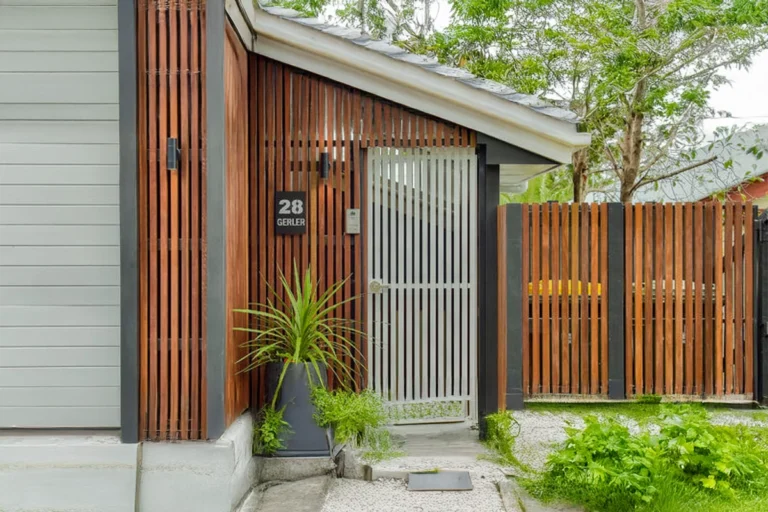
Slatted batten systems are a sophisticated solution, whether they are vertical privacy screens along boundary lines, horizontal timber batten screening around alfresco dining spaces, or decorative slatted timber screens masking utility spaces.
Selecting the right battens involves looking beyond aesthetics. The design of a screening system to withstand the harsh Australian sun, UV radiation, high wind loads and seasonal moisture changes needs consideration of timber species density, batten profile geometry, spacing ratios and structural sub-framing.
Section 1: Decoding Profile Geometry – Spacing, Depths, and Airflow Mechanics
The primary practical objective of feature screening battens is to control sightlines whilst still providing ventilation. Getting the right blend of privacy, shade and ventilation comes down to understanding three basic geometric dimensions.
1. The Width-to-Depth Ratio (3D Depth Effect)
Rather than using flat, thin timber slats ($19\text{mm} \times 42\text{mm}$), high-end architectural batten screens utilize deeper profiles, such as $42\text{mm} \times 42\text{mm}$ square battens or $42\text{mm} \times 65\text{mm}$ rectangular battens mounted end-on.
A dynamic visual privacy effect is produced by deeper profiles. Light and air can readily pass through the gaps when viewing the screen directly from the front. However, the depth of nearby battens seemingly overlaps when an observer moves to an angle, totally obstructing sightlines from nearby residences.
2. Batten Gap Ratios (The Goldilocks Zone)
- High Privacy (10mm to 15mm Gaps):Ideal for close neighbour boundaries, pool enclosure screening or spa areas. Provides approximately $75\%\text{ to } 85\%$ visual blockage, and allows light breezes to pass through.
- Balanced Shade & Filtered Light (20mm to 25mm Gaps):The standard for outdoor kitchen enclosures, pergolas, and patio screening. Provides the best possible sun shielding without sacrificing the feeling of an open, spacious outdoor space.
- Decorative Boundary Accents (30mm+ Gaps):Great for interior garden room dividers, trailing vine trellises and feature cladding on solid back walls.
3. Orientation: Vertical vs. Horizontal Battens
- Vertical Privacy Screen Battens: The preferred orientation for contemporary facades and small courtyards. Vertical lines draw the eye upward, creating an illusion of height. Functionally, vertical battens allow rainwater to shed rapidly down the grain, preventing water pooling on horizontal edges.
- Horizontal Timber Batten Screening:Ideal for expanding small outdoor areas and establishing tranquil, grounded outdoor living areas. To stop timber drooping over time, horizontal screening needs to be installed precisely and with strong intermediate supports.
Section 2: Material Selection Guide – Australian Hardwoods, Softwoods, and Composite Options
The material you choose for feature screening battens will control the extent to which your screen resists weathering, warping and insect attack.
Australian Hardwoods (The Gold Standard for Natural Beauty)
Native hardwoods offer unmatched surface character, high Janka hardness ratings, and natural durability against severe weather exposure.
- Spotted Gum: Highly favored across Australian outdoor designs for its rich, wavy grain and color spectrum ranging from warm honey to deep dark chocolate. Boasting a high Janka hardness rating of $11.0\text{kN}$, Spotted Gum offers superior dimensional stability and natural bushfire resistance (rated up to $BAL-29$).
- Blackbutt: A top choice for modern, light-toned architectural palettes. Blackbutt provides a clean straw-blonde color with high durability (Class 1 above ground). It takes clear oil finishes predictably while offering minimal expansion or contraction.
- Ironbark &Jarrah:Rich reddish-brown and deep red hardwoods with exceptional mechanical impact resistance and Class 1 durability are perfect for heavy-duty commercial or coastal screening applications.
Class 2 & Imported Timbers
- Merbau:A well-liked, reasonably priced hardwood praised for its exceptional natural durability and beautiful reddish-brown hue. Because Merbau contains a lot of naturally occurring tannins that are soluble in water, careful washing or pre-sealing is necessary at first installation to avoid tannin bleed into light-colored concrete or sandstone pavers.
- Treated Pine (H3 Rated):A lightweight softwood alternative that is inexpensive to install and simple to cut. H3 treated pine is still a sensible option for low-cost do-it-yourself screening applications, even though it needs to be painted or stained to stop quick UV deterioration.
Composite and Aluminium Alternatives
- Timber-Look Aluminium Battens:Powder-coated or timber-grain aluminium battens offer absolutely straight lines that never warp, cup, or need to be oiled for zero-maintenance applications or fire-prone areas needing non-combustible materials ($BAL-FZ$).
- Capped Wood-Plastic Composites (WPC):Composite screening battens, which are made of recycled wood fibres and polymers, provide uniform colour stability throughout contemporary outdoor screens by doing away with the need for sanding, painting, and staining.
Section 3: Engineering the Sub-Framing – Spans, Fasteners, and Airflow Clearance
Even the best slatted timber screening will sag, twist or bend if placed on an inadequate structural sub-frame. You want to follow three principles of engineering to make sure your structure is stable:
- Calculate Maximum Unsupported Batten Spans:Set intermediate sub-frame support posts to recommended maximum spans to prevent timber battens twisting or bowing along their length. Standard hardwood battens are 19 mm × 42 mm, and should be spaced from 600 mm to 800 mm on center. For battens that are 42 mm × 42 mm, spans can be increased to 1200 mm.
- Specify Marine-Grade Fasteners:When fixing battens outside always use countersunk screws in grade 304 or grade 316 stainless steel. Do not use standard steel or zinc-plated screws as the natural acid in hardwoods such as Spotted Gum will corrode cheap fasteners and cause black tannin staining around screw heads.
- Maintain Ground and Wall Clearances:Do not attach timber screening battens directly to soil, lawn or concrete pavers. Allow at least $50\text{mm} \text{ to } 75\text{mm}$ clearance between the bottom rail and the ground to prevent moisture absorption through the end grain and to provide a $20\text{mm}gap between sub-framing and masonry walls for continuous rear air circulation.
Section 4: Protective Coating Strategies and Ongoing Maintenance
Routine maintenance is the key to decorative batten screening having a long structural life and rich colour.
- Penetrating Timber Oils vs. Film Coatings: For exterior timber battens exposed to direct sun, choose high-quality penetrating exterior oils or micro-porous decking oils containing strong UV blockers. Avoid hard film-forming varnishes, which crack and peel under intense sun, requiring labor-intensive sanding before re-application.
- Pre-Sealing Prior to Assembly: The single most effective step in assembling a long-lasting timber screen is pre-oiling or priming all four sides of every batten before fixing them to the frame. Pre-sealing coats the hidden rear faces and end-grain cuts where water would otherwise seep in and trigger mold or rot.
- Ongoing Maintenance Cadence: Inspect your outdoor batten screens annually. For screens facing harsh northern or western afternoon sun, apply a quick re-oil every 12 to 18 months to maintain the wood’s natural oils, prevent micro-cracking, and stop the timber from weathering to a silver-grey patina.
Elevating Outdoor Privacy with Batten Screening
An open patio or basic boundary fence can become an architectural feature with the correct feature screening battens. Your outdoor haven will be able to endure the weather for many years if you balance the depth of the batten, choose long-lasting local hardwoods like Blackbutt or Spotted Gum, design robust sub-framing, and use protective timber oils.
Frequently Asked Questions (FAQ)
1. What is the best timber species for feature screening battens in outdoor coastal environments?
If you’re after a coastal screening project that’s going to be subjected to a lot of salt spray and humidity, then Class 1 native Australian hardwoods like Spotted Gum and Blackbutt are the best bet. They are extremely dense, shrink very little, and contain high levels of natural oils that make them highly resistant to salt air weathering, fungal rot and insect attack.
2.How far apart should feature screening battens be spaced for privacy?
For optimal residential privacy along boundary lines or pool zones, a gap spacing of 10mm to 15mm between battens is recommended. If you are installing deeper battens (such as $42\text{mm} \times 42\text{mm}$ profiles), you can widen the gap to 20mm while maintaining excellent privacy due to the 3D angle-of-view overlap effect.
3. Can feature screening battens be installed directly over an existing chain-link or paling fence?
Yes. You can fix vertical or horizontal timber screening battens over an existing fence structure by first installing a horizontal or vertical timber sub-frame (typically $45\text{mm} \times 70\text{mm}$ treated pine or hardwood battens) fixed securely to the main posts. Never screw screening battens directly into aging fence palings, as they lack the structural strength to support the extra weight.
4.How do I prevent Merbau screening battens from staining my concrete patio pavers?
Merbau contains high levels of natural water-soluble tannins that leach out when wet. To prevent staining nearby light-colored concrete or stone paving, pre-wash the Merbau battens using a timber cleaner or tannin stripper prior to installation, or apply a dedicated timber tannin sealer to all four sides before mounting the battens.
5. Are timber feature screening battens allowed for swimming pool safety barriers?
Yes, timber battens can be used as part of a compliant pool fence barrier, but they must be used in strict accordance with the safety guidelines outlined in Australian Standard AS 1926.1. Where vertical battens are used, the maximum gap between slats should be 100 mm, and the total height of the screen should be a minimum of 1200mm measured from the outside ground level. There should be no horizontal footholds which would allow children to climb.