
Ecoply F11 T&G H3 LOSP Treated Ply Flooring
$135.00 – $225.00
When a subfloor has to carry real loads — foot traffic, furniture, machinery, or the weight of an entire mezzanine level — the sheet material underneath matters more than most people realise. EcoPly F11 T&G Flooring is a structural plywood panel engineered specifically for this job. It is manufactured from rotary-peeled radiata pine veneers, cross-laminated at right angles to each other and bonded under heat and pressure with a Type A phenolic resin, the same bond type used across Australia’s structural plywood industry because it holds up in both dry and damp conditions without delaminating.
The “F11” in the name refers to the stress grade assigned to the panel under AS/NZS 2269, the Australian and New Zealand Standard for structural plywood. Stress grades measure a panel’s bending strength and stiffness parallel to the face grain, and F11 sits above the more commonly stocked F8 grade. In practical terms, an F11 sheet can span further between joists or bearers, or carry a heavier point load over the same span, without the visible deflection that thinner or lower-grade sheets show under weight. For flooring specifically — where people walk, stack, and sometimes drop things — that extra stiffness translates into a quieter, firmer floor with less bounce underfoot.
Melbourne Timber Supplies stocks EcoPly F11 T&G Flooring as a main product line spanning two distinct sub-ranges: an untreated Ecoply F11 T&G Flooring for internal, dry-condition subfloors, and an Ecoply F11 Treated Flooring preserved to H3 for applications exposed to weather or persistent moisture. Both sub-ranges share the same core construction and stress grade — the difference comes down to the preservative treatment applied before pressing, and the sheet thicknesses each range is stocked in.
Ordinary interior-grade plywood is not rated for load-bearing use — it is tested for appearance, not strength. Structural plywood such as EcoPly F11 goes through a different certification pathway. Every panel is manufactured under a third-party audited quality programme and certified by the Engineered Wood Products Association of Australasia (EWPAA), which checks that the glue bond, veneer thickness and stress properties genuinely meet what is printed on the panel’s grade stamp. When a builder or engineer specifies F11 plywood on a set of drawings, that certification is what lets them trust the number without re-testing every sheet that arrives on site.
The panel carries a CD face grade, meaning one face is a sanded C-grade veneer suitable for direct use as a flooring surface or substrate, while the reverse D-grade face is left unsanded since it typically sits against joists and is never seen once installed. Underneath the face veneer, EcoPly Flooring panels include a second void-free layer, which reduces the risk of moisture bubbling or the face veneer punching through under a concentrated point load — a detail that matters more in flooring than in wall or roof sheathing, where loads tend to spread more evenly across the panel.
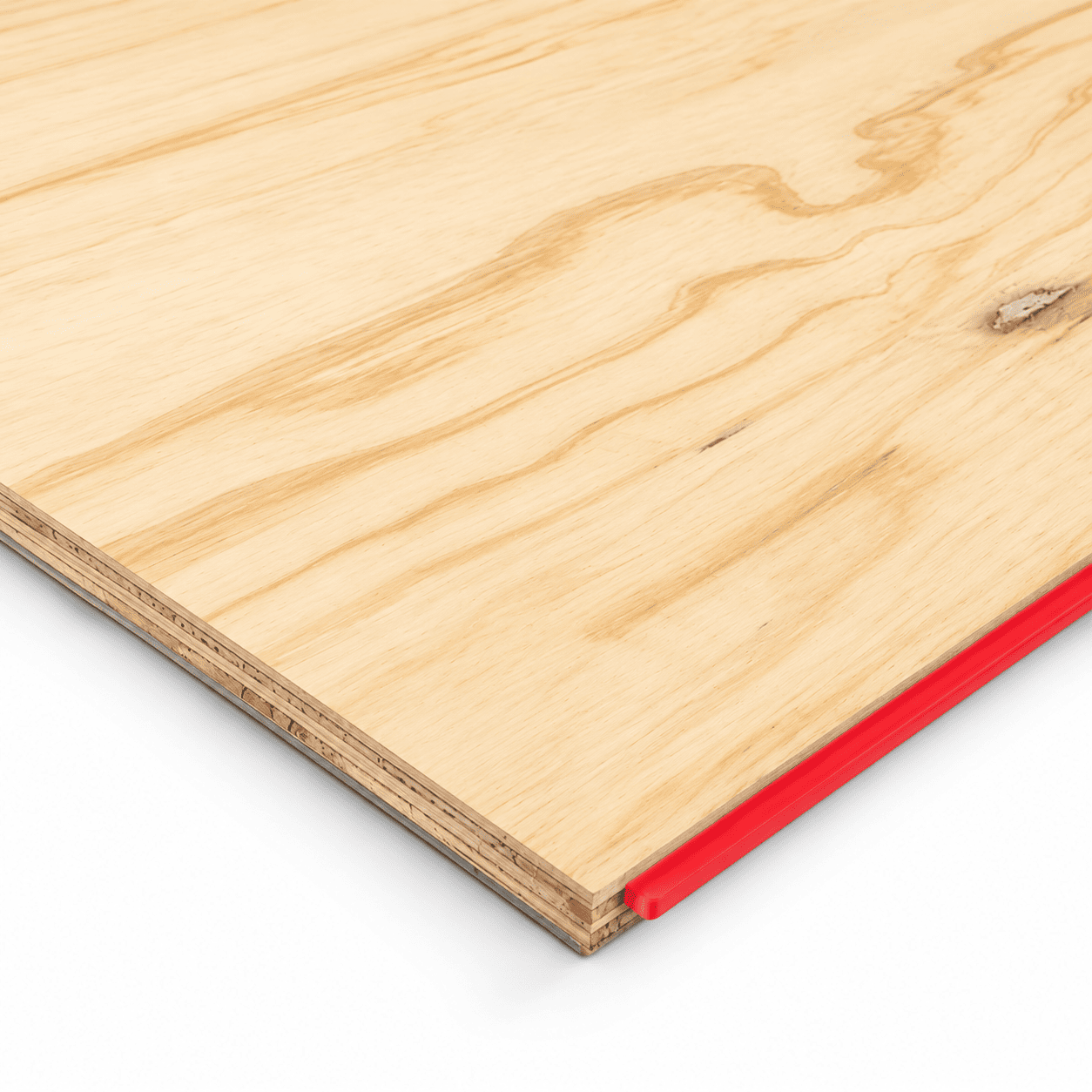
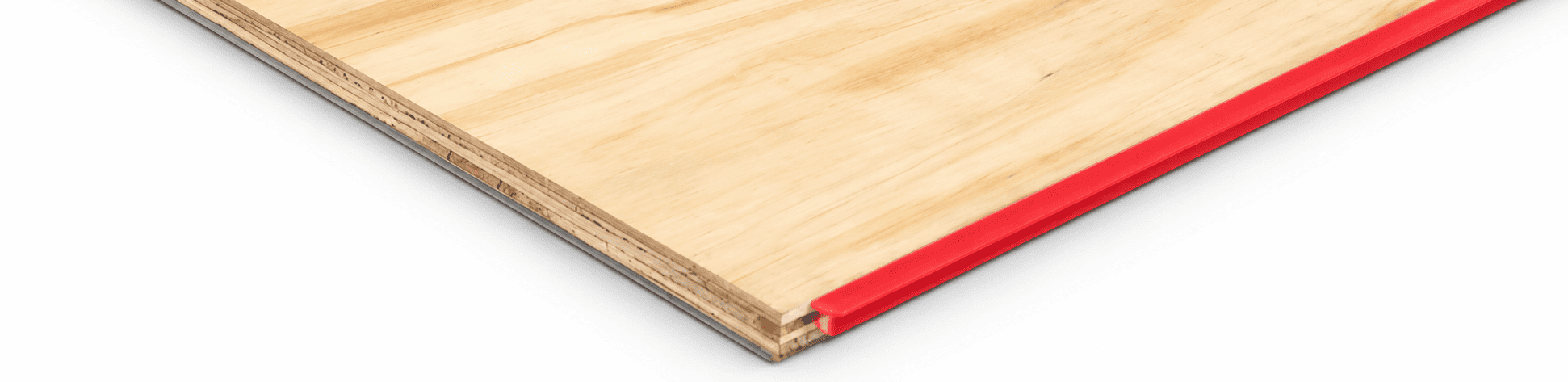
Every sheet in the range is machined with a groove running along both long edges, with a polypropylene plastic tongue pressed into one side. When two sheets meet, the tongue slots into the groove of the adjoining panel, locking the two together along a joint that would otherwise be a weak point. This does two things for a finished floor. First, it keeps adjoining sheet edges level with each other, so foot traffic does not create a step or a gap at every join. Second, it lets sheets share load across that join — a joist does not need to sit directly under every single edge, because the T&G profile transfers part of the load sideways into the next panel.
That is part of why F11 T&G flooring sheets, sold in the same 2400 x 1200mm format across every thickness in the range, get specified over square-edge structural ply wherever the panel is actually going to be walked on.
The untreated Ecoply F11 T&G Flooring range, stocked in 12mm, 15mm, 17mm, 19mm, 21mm and 25mm thicknesses, is intended for enclosed, dry subfloor applications — think residential upper-storey flooring, internal mezzanines, and covered commercial floor decks where the panel will not see rain, ground contact, or sustained damp. Because no preservative treatment is applied, it is generally the more cost-effective option wherever moisture exposure genuinely is not a factor.
The Ecoply F11 Treated Flooring range, available in 15mm, 17mm, 19mm and 25mm, goes through an H3 preservative treatment process before it leaves the mill. H3-treated plywood is rated for above-ground exterior use where the timber will be exposed to periodic wetting — verandah and balcony subfloors, external deck substrates, carports, and similar semi-exposed structures. The treatment does not change the panel’s stress grade or its tongue and groove profile; it changes the panel’s ability to resist decay and insect attack over years of exposure to weather that an internal-only sheet was never designed to handle. Builders sometimes ask whether a coat of exterior sealant on an untreated sheet is an adequate substitute — it is not, because sealants address surface moisture, while preservative treatment is what manages the biological risk at the timber’s core.
Thickness selection generally comes down to joist spacing and expected load rather than personal preference. Thinner sheets — 12mm and 15mm — suit closer joist centres and lighter residential loads. Moving up to 17mm and 19mm accommodates wider joist spacing or heavier foot traffic, which is why 19mm is a common specification for mezzanine and commercial subfloors. The 21mm and 25mm sheets at the top of the untreated range, and the 25mm option in the treated range, are typically reserved for longer unsupported spans or floors that need to carry unusually heavy or concentrated loads, such as storage mezzanines or workshop floors.
If there is any doubt about which thickness a project needs, it is worth checking span tables against the actual joist spacing rather than assuming a thicker sheet is automatically the safer choice — over-specifying thickness adds cost and weight without a corresponding structural benefit once the span requirement is already met.
Sheets should be laid with the face grain running perpendicular to the joists wherever spans allow, staggering end joints from row to row so that four sheet corners never meet at a single point. Leave the recommended expansion gap at sheet ends and unglued edges to allow for minor moisture-related movement, and glue-and-screw fix panels to joists rather than relying on screws alone — the combination reduces squeaking over the life of the floor. Treated sheets that are cut on site should have the exposed edge re-sealed with an appropriate end-seal or preservative touch-up, since cutting removes the treated surface from that edge and exposes untreated core material underneath.
Radiata pine used in EcoPly panels comes from managed plantation forests rather than native timber, and FSC-certified stock can be requested where a project’s sustainability documentation calls for it. Because plywood makes efficient use of the log — rotary-peeling veneer wastes far less timber than sawing solid boards — it is often the more resource-efficient structural choice for flooring compared with sawn timber alternatives of equivalent strength.
Each panel is branded along one edge with a grade stamp that records the stress grade, glue bond type, face grade and the EWPAA certification mark, so the sheet can still be identified after it has been cut into flooring and boxed in under a finished surface. On larger jobs where an engineer has specified F11 plywood for a particular span, that stamp is often the only proof on site that the correct product was actually installed, which is worth checking before sheets go down rather than after. Melbourne Timber Supplies can also provide EWPAA compliance certificates and technical data sheets on request, useful when a certifier or building surveyor wants documentation attached to a project file rather than just a grade stamp photographed on site.
Melbourne Timber Supplies carries the full EcoPly F11 T&G Flooring range — both the untreated and H3-treated sub-products — as stock sheets in the standard 2400 x 1200mm format. Builders working to a tight program do not want to wait on a mill order for a subfloor material, and having both ranges on the shelf across all listed thicknesses means a job can move from quote to delivery without the panel becoming the bottleneck. Every sheet supplied carries the AS/NZS 2269 and EWPAA certification that lets it be specified with confidence on structural drawings, whether the end use is a straightforward residential subfloor or a commercial mezzanine deck.
For projects that mix conditions — an internal subfloor that also needs to extend under a covered but partially exposed verandah, for instance — it is common to specify the untreated range internally and the H3-treated range wherever the floor meets the weather, keeping both material cost and long-term durability in line with what each section of the floor actually needs. Our team can help match thickness and treatment to a specific span table or site condition — get in touch with Melbourne Timber Supplies for current stock availability and a quote.