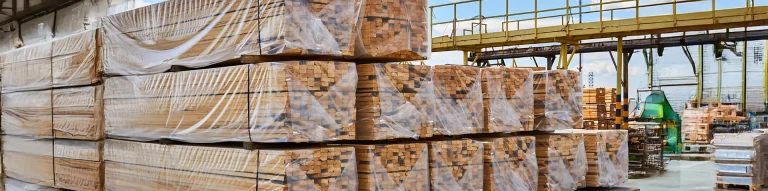


Flooring is a critical structural element in today’s industrial facilities, logistics hubs and high-traffic commercial spaces. A warehouse floor is subjected to dynamic impact forces, localised static point loads of high-bay pallet racking, and the continuous shear stress of heavy forklift traffic everyhour.
While steel-reinforced concrete slabs are traditionally viewed as the primary sub-base for industrial facilities, solid structural timber and heavy-duty engineered wood systems are experiencing a major architectural resurgence.
Timber offers outstanding strength-to-weight ratios, natural shock absorption, high chemical resistance, and substantial embodied-carbon benefits for commercial developments.
However, when specifying timber for commercial flooring or industrial distribution centres, you need to look beyond decorative aesthetics. To engineer an industrial wood floor that will support heavy loads without deflection, crushing, or seam shear, you must consider mechanical stress elements, timber density factors, subfloor support grids, and protective coating formulas.
1. Mechanical Stress Vectors in Industrial Environments
Before selecting a timber species or board profile, you must understand the three mechanical stress forces acting on a commercial floor plane:
- Static Point Loads (High-Bay Racking):Pallet racking posts transfer thousands of kilograms to tiny steel baseplates of only $100\text{mm} \times 100\text{mm}$. If the underlying timber does not have an adequate Janka hardness or compressive strength perpendicular to the grain, the baseplate will crush the top wood fibres, resulting in systemic rack misalignment and dangerous structural instability.
- Dynamic Impact Loads:Loading docks, assembly lines and places with heavy machinery are exposed to permanent dynamic shock. The flooring material must be able to absorb and dissipate the kinetic energy of a heavy crate or heavy tooling component falling from a height, without fracturing or cracking along grain lines.
- Rolling Wheel Shear Stress:Localised friction and horizontal shear stress are experienced by heavy forklifts, reach trucks and motorised pallet jacks from hard-polyurethane or steel wheels. Tongue-and-groove joins are prone to delamination and hazardous trip points when subjected to continuous rolling loads that can shear off edges of the board.
2. Timber Selection Matrix: Matching Species to Load Benchmarks
There are three main physical properties to consider when selecting wood for heavy-duty industrial and commercial use:
- Janka Hardness Rating ($kN$): Shows the resistance to surface indentation and crushing under static point loads.
- Modulus of Rupture ($MoR$, in $MPa$): Maximum bending strength of the board before it breaks.
- Modulus of Elasticity ($MoE$ in $GPa$): The rigidity of the material and its ability to resist bending deflection under dynamic weight.
Species Performance Profiles
- Red Ironbark (Ultra-Heavy Industrial Grade):Hardness $14.0+\text{ kN}$ Janka, MoR $\approx 175\text{ MPa}$ and MoE $\approx 22\text{ GPa}$. Widely used in industrial workshops, loading bay platforms and distribution warehouses for heavy machinery. Pallet legs have a dense structure of cells that resist deep point-load indentation. They also contain high levels of natural oil for better moisture resistance.
- Spotted Gum (Commercial & High-Traffic Grade):Janka hardness of $11.0\text{ kN}$, $MoR \approx 150\text{ MPa}$, and $MoE \approx 18\text{ GPa}$ has an interlocking grain pattern that keeps it from splintering when pallet jacks are driven aggressively. It is perfect for open-plan commercial floors where aesthetic appeal and high foot traffic coexist because it strikes a compromise between extraordinary durability and a striking natural look.
- Blackbutt (Commercial Showrooms & Mezzanines):Janka hardness of $9.1\text{kN}$, $MoR \approx 140\text{ MPa}$. Excellent for contemporary retail spaces and mezzanine office areas requiring a bright, neutral blonde wood finish with high natural strength.
- Cross-Laminated Timber / CLT (Heavy Industrial Engineered Subfloors): Alternating layer orientations eliminate the natural grain weaknesses found in raw timber slabs. $CLT$ structural flooring panels function as both the structural diaphragm and the finished ceiling beneath, spanning large distances between structural steel beams while safely carrying live commercial loads of $5.0\text{ to }10.0\text{ kPa}$.
3. Subfloor Structural Mechanics: Engineering the Joist Grid
The strength of the surface is determined by the frame support grid under a heavy-duty hardwood surface. When installing warehouse timber flooring or mezzanine decking, you need to design the framing spacing so that concentrated loads from equipment won’t deform the subfloor.
- Standard Commercial Joist Spacing: While residential floors utilise$450\text{mm}$ or $600\text{mm}$ joist centres, high-load industrial mezzanines require tightened joist grids set at $300\text{mm}$ to $400\text{mm}$ centres.
- Board Thickness Benchmarks: Standard $19\text{mm}$ commercial boards are suitable for foot traffic and light trolley distribution. However, true heavy industrial floors operating forklifts require extra-thick $32\text{mm}$ to $45\text{mm}$ structural tongue-and-groove hardwood boards or engineered mass timber panels.
- Nogging and Edge Bridging:Place solid steel or hardwood noggins between the framing joists directly below the high-bay racking feet and main transit aisles to distribute point loads over several structural beams at the same time.
4. Protective Industrial Coatings and Slip Resistance Compliance
In a commercial situation, leaving an industrial timber floor unsealed will lead to early mechanical wear, oil absorption and rapid chemical deterioration. Protective coatings must also meet strict occupational health and safety regulations as well as abrasion resistance.
High-Build Polyurethane Systems
Over the wood fibres, multi-pack industrial polyurethane sealers create a thick, protective layer. They offer excellent scratch resistance against rolling wheel traffic and stop spilt chemicals, hydraulic oil, and grease from penetrating the porous grain.
Slip Resistance Compliance (AS 4586 / OSHA Standards)
Commercial and industrial floors must meet stringent slip-resistance friction standards in critical areas such as entryways, wash bays or packing lines where liquid spills are prevalent.
- Wet Pendulum Test Ratings: Commercial floors require a minimum rating of P3 to P5 (depending on environmental moisture exposure).
- Aggregate Integration: To meet elevated slip-resistance targets without ruining the natural beauty of the timber, industrial coatings incorporate aluminium oxide or fine quartz aggregates into the top clear seal coat, creating a non-slip, textured finish.
Balancing Industrial Strength with Sustainable Design
It is necessary to analyse material mechanics, dynamic load factors, subfloor structural engineering, and protective surface finishes to specify the appropriate structural timber for commercial and warehouse situations.
Developers can create commercial flooring that can resist large forklift loads, high-bay racking, and constant traffic by substituting high-density native hardwoods like Red Ironbark and Spotted Gum for thin softwoods or by using mass timber $CLT$ panels supported by tighter joist frameworks.
Investing in high-performance structural timber delivers an industrial floor that handles extreme operational stress while lowering the building’s overall carbon footprint for decades to come.
Frequently Asked Questions (FAQ)
Can solid timber flooring support heavy forklift traffic in a warehouse environment?
As long as the floor system is properly designed, solid wood can sustain forklift usage. Extra-dense Class 1 hardwoods (such as Red Ironbark or Grey Box) with a minimum thickness of $32\text{mm} \text{ to } 45\text{mm}$ must be laid over tight $300\text{mm}$ to support the concentrated axle weight of a $3\text{-ton}$ to $5\text{-ton}$ forklift. Solid steel sub-framing or structural joist centres.
How does mass timber ($CLT$) compare to steel-reinforced concrete for commercial mezzanine floors?
Cross-Laminated Timber ($CLT$) has a number of distinct advantages over traditional concrete slabs on upper-story commercial mezzanines. $CLT$ panels can reduce the dead load on the building’s main base and speed up installation times by up to 50% because they are significantly lighter than concrete. Additionally, the mezzanine floor is a carbon-sink asset that can readily accommodate commercial live loads of $5.0$ kPa or more since $CLT$ stores carbon.
What is the best way to prevent pallet racking feet from crushing commercial timber floors?
Install wide heavy-gauge steel spreader plates underneath each upright footplate to prevent heavy pallet rack feet from crushing wood fibres under extreme static point stresses. These plates keep the localised load within the permissible compressive stress limits perpendicular to the grain ($F’_{c\perp}$) of the timber species by dispersing the focused downward force over a greater surface area.
How do you handle moisture expansion in large commercial timber floor layouts?
Large sections of wood absorb atmospheric moisture in wide warehouse or commercial floor plans, causing the floor to expand throughout its breadth naturally. Every 6 to 8 meters across the floor plane, structural installers use 10 to 15 mm intermediate expansion joints filled with heavy-duty industrial elastomeric polyurethane sealants that expand and contract with the wood to prevent buckling or edge lifting.
Are industrial timber floors more fire-resistant than unprotected structural steel framing?
Indeed. Through a process known as charring, thick structural timber beams and mass timber panels like $CLT$ demonstrate consistent, high fire resistance.
The timber structure retains its load-bearing strength long after exposed steel beams would soften, bow, and collapse because the exterior layer of wood chars at a slow, predictable rate ($\approx 0.65\text{mm/min}$) when exposed to severe fire.