Creating an inviting outdoor space requires a smart balance of privacy, sunlight, and ventilation. Solid brick walls or colorbond fencing can leave backyards feeling boxed in, while lightweight shade cloths rarely provide the high-end finish modern homes demand.
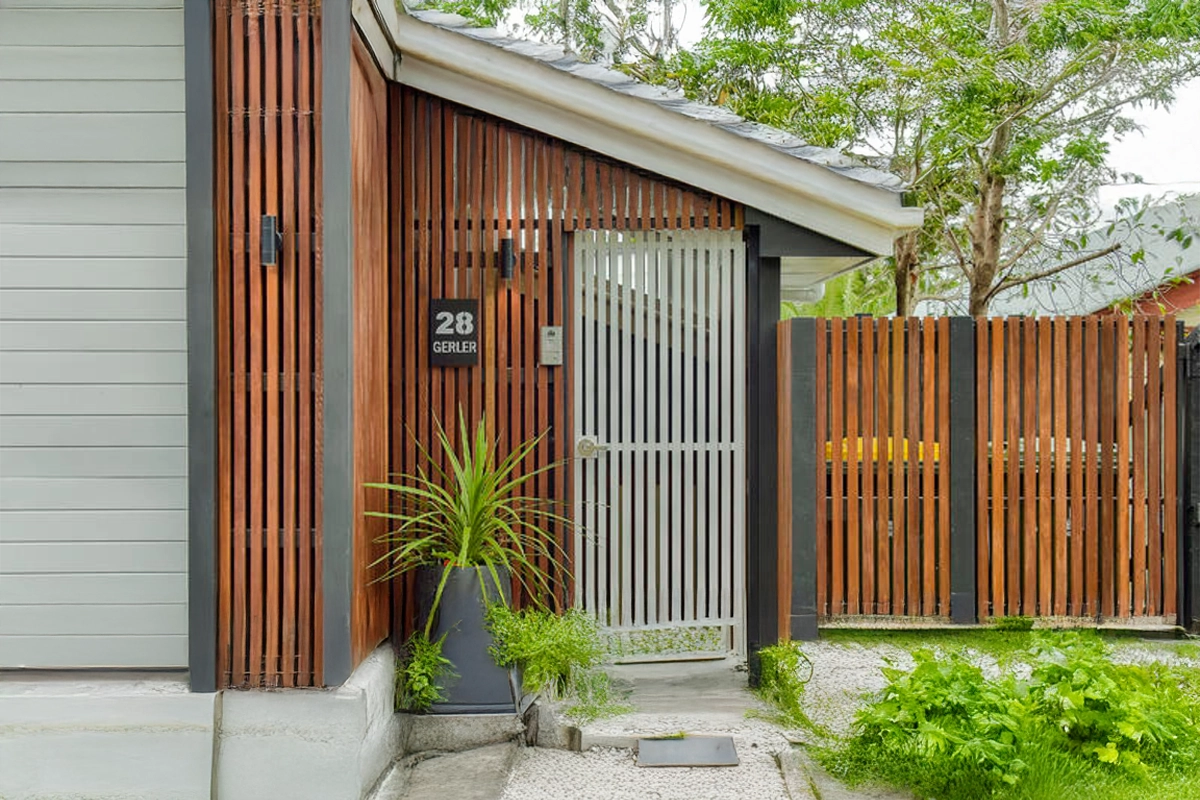
External screening battens provide an excellent architectural solution. Homeowners can block unpleasant sightlines while preserving breezy outdoor airflow by installing slatted timber screens across building facades, along patio perimeters, and along boundary lines.
However, selecting timber for external screening battens requires evaluating more than just initial surface colour. Timber installed outdoors faces intense UV rays, seasonal rainfall, extreme heat, and humidity.
If you specify the wrong wood species, your privacy screen can quickly warp, cup, twist, or decay. This comprehensive guide breaks down the best-performing hardwood, softwood, and composite options for external timber screening battens, helping you choose the right material for your climate, design vision, and budget.
Key Performance Criteria: How to Evaluate Exterior Timber
Understanding the physical factors that affect how long a timber screen will remain outdoors is essential before looking at particular species.
Natural Durability Class
Class 1 Species have the highest natural resistance to rot, fungal decay and subterranean termites in exposed outdoor situations. Timber standards rank species from Class 1 to Class 4 according to the natural resistance to rot, fungal decay and subterranean termites:
- Class 1 (Highest Durability): Above-ground lifespan of 25+ years with minimal maintenance.
- Class 2 (High Durability): Above-ground lifespan of 15 to 25 years.
- Class 3 & 4 (Moderate to Low Durability): Suitable only for sheltered interior applications or requiring heavy preservative treatment for outdoor use.
Janka Hardness Rating ($kN$)
The Janka hardness test is a measure of a wood’s resistance to dents, scratches and mechanical wear. The higher the Janka rating ($9.0\text{ kN}$ to $14.0+\text{ kN}$), the denser and heavier the wood, which means it will hold screws tightly, resist surface splintering, and withstand high winds and hail.
Dimensional Stability and Movement
All outdoor timbers will naturally absorb moisture from the air and expand, then shrink as they dry out in the sun. Timbers have low shrinkage rates and straight grain patterns, giving high dimensional stability so your external screening battens stay straight and true for years and years without twisting off their frame.
Top Australian Hardwoods for External Screening Battens
For timber external screening battens, native Australian hardwoods are typically regarded as the standard material. These species have higher density and natural oil protection because they evolved to grow in hostile climates.
Spotted Gum (The Premier All-Rounder)
- Durability Rating: Class 1 Above Ground
- Janka Hardness:$11.0\text{ kN}$
- Visual Appeal: Rich color variation ranging from soft honey-gold to dark chocolate brown, featuring a wavy, interlocked grain.
Why It’s Ideal: Spotted Gum is one of the most stable Australian hardwoods available. Its high density and natural oils give it incredible resistance to checking, twisting, and splitting. Furthermore, Spotted Gum is naturally fire-resistant, meeting Bushfire Attack Level standards up to $BAL-29$ under AS 3959 without needing chemical treatments.
Blackbutt (Modern, Clean, and Light-Toned)
- Durability Rating: Class 1 Above Ground
- Janka Hardness:$9.1\text{ kN}$
- Visual Appeal: Even, straw-blonde to pale cream tones with a smooth, straight grain profile.
Why It’s Ideal:Blackbutt is very popular with contemporary architects designing coastal or minimalist homes, taking clear protective oils and light stains predictably. Its straight grain provides superb dimensional stability, meaning that horizontal or vertical external screening battens will maintain sharp visual lines over long spans.
Red Ironbark (Ultimate Density and Strength)
- Durability Rating: Class 1 Above Ground
- Janka Hardness:$14.0+\text{ kN}$
- Visual Appeal: Deep, dramatic reddish-brown tones ranging from plum to dark chestnut.
Why It’s Ideal:Red Ironbark is practically unbreakable if your screen is located in a windy environment or needs to be extremely durable against physical contact. It is a perfect fit for heavy-duty screening because its strong grain structure provides natural termite resistance and resists deep surface scratches.
Silvertop Ash (Budget-Friendly Native Choice)
- Durability Rating: Class 2 Above Ground
- Janka Hardness:$8.0\text{ kN}$
- Visual Appeal: Pale warm brown with subtle pink undertones, often featuring character-rich gum veins.
Why It’s Ideal: An affordable starting point for authentic Australian hardwood screening is Silvertop Ash. It is well-liked for acoustic boundary fencing and suburban privacy screens because it meets $BAL-29$ bushfire criteria and finishes well with penetrating oils.
Imported Hardwoods and Softwood Alternatives
Many imported timbers and treated softwoods provide useful substitutes if native hardwoods are too expensive or don’t fit your preferred colour scheme.
Merbau (Traditional Value Option)
- Durability Rating: Class 2 Above Ground
- Janka Hardness:$8.6\text{ kN}$
- Visual Appeal: Deep, uniform reddish-orange brown with small golden flecks in the grain.
Why It’s Ideal: Merbau is a widely accessible, highly durable hardwood for external screening battens. It resists rot and insect attack exceptionally well.
Important Note: Merbau contains a lot of naturally occurring water-soluble tannins. It will leak red tannins over nearby surfaces when exposed to the first rain. Merbau battens should always be pre-washed or given a tannin-sealing lacquer before being placed next to light-colored stone or concrete paving.
H3 Treated Radiata Pine (Budget DIY Choice)
- Durability Rating: Class 1 (Chemical Treatment)
- Janka Hardness:$3.3\text{ kN}$
- Visual Appeal: Pale greenish-yellow timber that requires painting or staining.
Why It’s Ideal: H3 treated pine is infused with copper-based preservatives to protect against fungal decay and termites. It is lightweight, easy to cut, and highly affordable for DIY projects. However, because pine is a soft wood with low density, it requires frequent painting or staining to prevent rapid UV drying, warping, and surface splintering.
Timber vs. Composite and Aluminum Screening Battens
Natural timber offers a unique organic warmth and depth of appearance, but other materials have found their way into the specification of contemporary buildings.
Natural Timber Screening
- Pros: Authentic grain texture, superior structural feel, easily refinished, stores embodied carbon.
- Cons: Requires periodic re-oiling or painting every 12 to 24 months to maintain color and prevent weathering.
Capped Wood-Plastic Composite (WPC) Battens
- Pros: Made from recycled polymers and wood fibers; requires no sanding, staining, or oiling; highly resistant to fading.
- Cons: Can expand lengthwise in high heat; lacks the unique grain variations of natural timber; higher initial material cost.
Powder-Coated Aluminum Timber-Look Battens
- Pros: Completely non-combustible ($BAL-FZ$ fire rated); lightweight; perfectly straight over long spans; zero structural maintenance.
- Cons: It has no inherent tactile warmth, is susceptible to dents from heavy lawn care equipment, and is difficult to repair if scratched.
Best Practices for Installing External Screening Battens
To maximize the lifespan of your chosen timber and prevent structural sagging, follow these key installation guidelines:
- Space Your Sub-Framing Correctly:For typical $19\text{mm}$ thick battens, keep intermediate support posts or cross-battens no more than $600\text{mm} \text{ to } 800\text{mm}$ apart. Long-term timber bowing is avoided as a result.
- Use Stainless Steel Fasteners: Always fix external timber screening battens using Grade 304 or 316 stainless steel countersunk screws. Standard galvanized or zinc screws react with natural hardwood tannins, leaving unsightly black stains around fastener holes.
- Pre-Seal All Six Sides: Before screwing battens onto your sub-frame, apply a coat of exterior penetrating oil or primer to all four sides and both cut end-grains. Pre-sealing stops moisture from soaking into hidden rear faces where air circulation is restricted.
- Maintain Ground Clearance: Ensure the bottom ends of vertical or horizontal battens sit at least $50\text{mm}$ above concrete or $75\text{mm}$ above soil to prevent capillary water absorption.
Which Timber Should You Choose?
Selecting the best timber for external screening battens comes down to your priorities:
- For maximum durability, beauty, and bushfire protection, choose Spotted Gum or Red Ironbark.
- For a clean, light-toned contemporary facade, specify Blackbutt or Silvertop Ash.
- For high durability on a modest budget, opt for Merbau (with proper tannin management).
- For low-cost DIY privacy screens, use H3 Treated Pine finished with a quality exterior paint.
By pairing a durable timber species with proper installation techniques and regular oiling, your external screening battens will remain a stunning architectural feature for decades.
Frequently Asked Questions (FAQ)
Which timber is best for external screening battens in coastal areas with high salt spray?
Class 1 natural Australian hardwoods, such as Blackbutt and Spotted Gum, are perfect for harsh coastal settings. They are extremely resistant to fungal rot, wind-driven rain, and salt air corrosion due to their high natural oil content, great density, and Class 1 durability ratings.
How often do external timber screening battens need to be re-oiled?
Every 12 to 18 months, apply a new layer of premium penetrating timber oil to screens that are exposed to direct afternoon sun in the north or west. Re-oiling screens beneath covered patios or in shady locations every two to three years is typically enough to preserve colour and UV protection.
What gap size should I leave between external screening battens for optimal privacy?
The best compromise between obstructing sightlines and permitting airflow for boundary privacy screens is a gap of 10 to 15 mm between battens. Because of the 3D depth overlap when viewed from an angle, you can increase the gap to 20mm when using deeper batten profiles (such as $42\text{mm} \times 42\text{mm}$ square battens) without sacrificing privacy.
Can I let my external hardwood screening battens weather naturally to a silver-grey color?
Yes. If you prefer a rustic, low-maintenance aesthetic, you can leave high-density hardwoods like Spotted Gum or Blackbutt uncoated. Over 12 to 24 months, UV exposure will silver the surface wood fibers. While this does not affect the core structural integrity of Class 1 hardwoods, applying a clear water-repellent sealer occasionally is still recommended to prevent surface checking and end-grain splitting.
Why are my Merbau external screening battens bleeding red liquid after rain?
Merbau contains high concentrations of natural water-soluble tannins. When rain hits unsealed Merbau, these tannins wash out as a reddish-brown liquid that can stain light-colored concrete, stone, or rendered walls. To prevent this, pre-wash Merbau battens with a dedicated tannin cleaner before installation, or apply a high-grade tannin sealer to all six sides before mounting the screen.